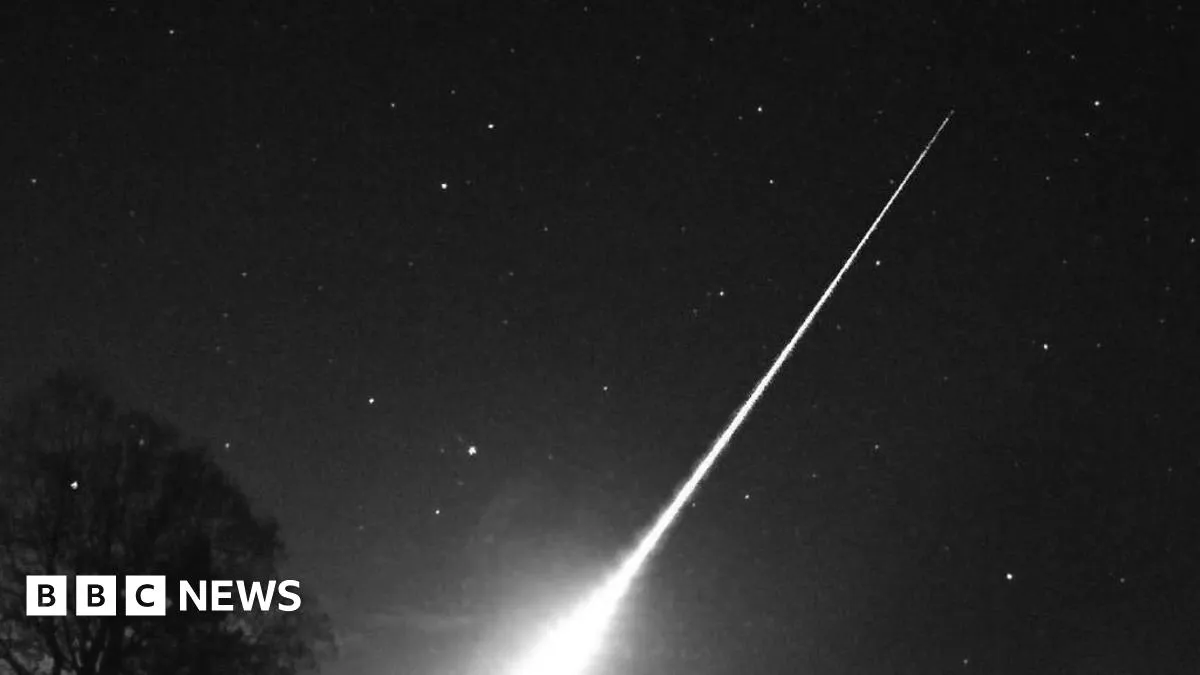
In a remarkable celestial event, a meteor was spotted in the skies above East Yorkshire and Lincolnshire at 00:24 BST. This fireball, which illuminated the night sky, has captured the attention of both amateur and professional astronomers alike.
According to the UK Fireball Alliance, the meteor’s trajectory suggests that it occurred over the North Sea, leading to the unfortunate conclusion that any recoverable meteorites are unlikely. Charlotte Bays, a representative from the alliance, stated, “Based on the fireball trajectory, the event occurred over the North Sea so, sadly, we do not expect any recoverable meteorites.” This highlights the ephemeral nature of such events, as meteors typically burn up in the atmosphere before reaching the ground.
This meteor sighting comes at an opportune time, as stargazers are gearing up for the Lyrids meteor shower, which is set to begin on April 14 and run until April 30, 2026. The Lyrids, known for producing a medium rate of shooting stars, will peak on the night of April 21 into the early morning of April 22, 2026. During this peak, observers can expect to see around 5-6 meteors per hour, making it an exciting time for astronomy enthusiasts.
The Lyrids meteor shower is particularly notable as it is composed of debris left behind by Comet Thatcher. This annual event is one of the first meteor showers of the year and is best viewed in the Northern Hemisphere. Stargazers are advised to look towards the east after 10 p.m. local time on April 21 to catch the best views of the meteors. NASA recommends that viewers ensure they have a clear view of the entire night sky, especially as multiple showers may occur simultaneously, allowing for a spectacular display.
Interestingly, meteors observed during the Lyrids typically lack the long tails that are commonly associated with shooting stars. Instead, they often appear as bright streaks across the sky. This unique characteristic adds to the allure of the Lyrids, making it a favorite among skywatchers.
As the date for the Lyrids approaches, excitement is building within the astronomical community. NASA has emphasized the importance of timing and location for optimal viewing, stating, “The best time to see the meteor shower is during its peak, in the dark hours after the moon sets and before the sun rises.” With the moon expected to be only 27% full during this peak, conditions should be favorable for viewing.
While the recent meteor sighting has sparked interest, it also serves as a reminder of the transient nature of these celestial phenomena. Meteors burn up in the atmosphere, while meteorites are less frequent and generally large enough to survive the heat and land on Earth’s surface. As such, finding material from the recent meteor is highly unlikely.
As we look forward to the Lyrids meteor shower, it is clear that the skies above East Yorkshire and Lincolnshire have much to offer both now and in the future. With the right conditions and a bit of patience, stargazers can look forward to an enchanting display of shooting stars in the coming years.