What the data shows
The discovery of Ichthyotitan severnensis raises an intriguing question: how did this newly identified species of marine reptile thrive during the Late Triassic period? The answer lies in the remarkable fossil evidence uncovered by 11-year-old Ruby Reynolds and her father on a beach in Blue Anchor, Somerset, on May 1, 2020.
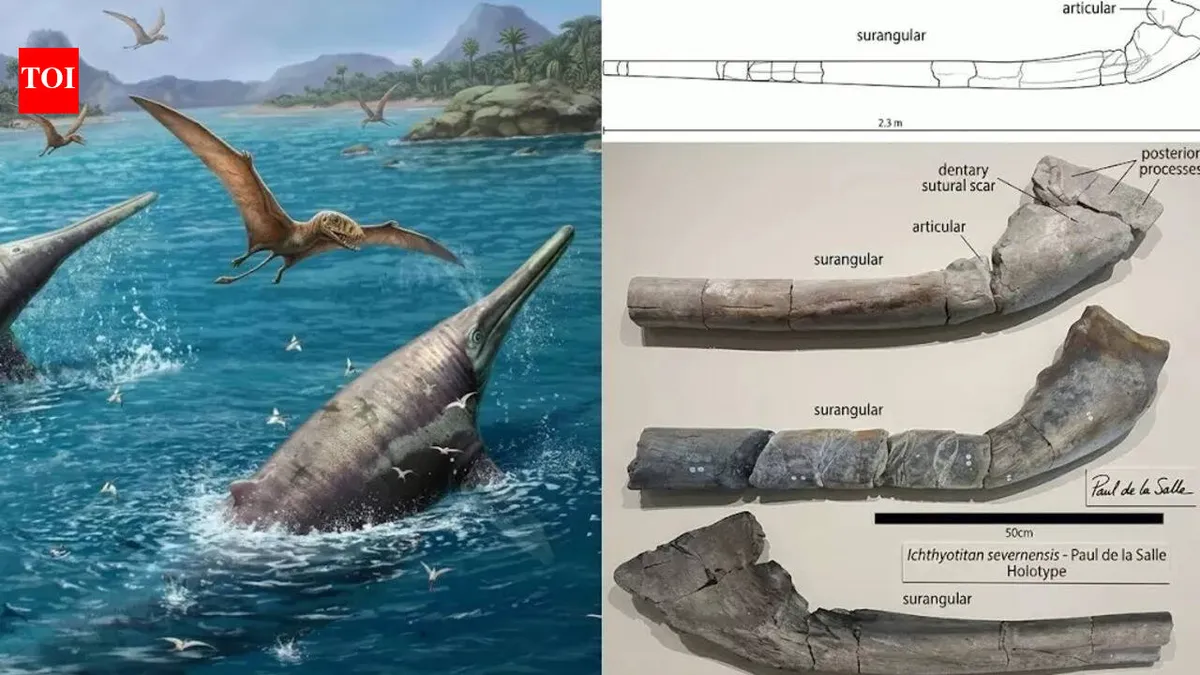
Ichthyotitan severnensis, which translates to ‘giant fish lizard of the Severn Estuary’, is estimated to have reached lengths of 82 feet, comparable to that of a modern blue whale. The fossil jawbone found measures over 6.5 feet long, indicating the extraordinary size of this creature. The fossils date back approximately 202 million years, a time when the oceans were undergoing significant changes.
This significant discovery challenges previous beliefs about the timeline of giant ichthyosaurs, suggesting that they were still thriving near the end of the Triassic period. Dean Lomax, a paleontologist from the University of Bristol, noted, “These jawbones provide tantalizing evidence that perhaps one day a complete skull or skeleton of one of these giants might be found. You never know.”
The fossils were part of the Westbury Mudstone Formation, a geological layer known for its rich fossil deposits. The jawbone’s size and the context of its discovery highlight the importance of amateur fossil hunters in contributing to major scientific breakthroughs. As noted in the findings, “Perhaps most remarkably, the discovery highlights how amateur fossil hunters, and even children, can contribute to major scientific breakthroughs.”
Furthermore, the fossil discovery involved not only the jawbone but also a four-inch bone fragment found by Ruby’s father, which adds to the excitement surrounding the find. The discovery is particularly significant as it occurred during a period of mass extinction, approximately 201 million years ago, which saw the decline of many species.
Looking ahead, further expeditions are planned to search for additional remains of Ichthyotitan severnensis along the English coastline. This ongoing research may provide more insights into the life and environment of this giant marine reptile.
As scientists continue to study the implications of this discovery, details remain unconfirmed regarding the full extent of Ichthyotitan severnensis and its ecological role during its time. The excitement surrounding this find not only enriches our understanding of prehistoric marine life but also emphasizes the value of community involvement in paleontological research.