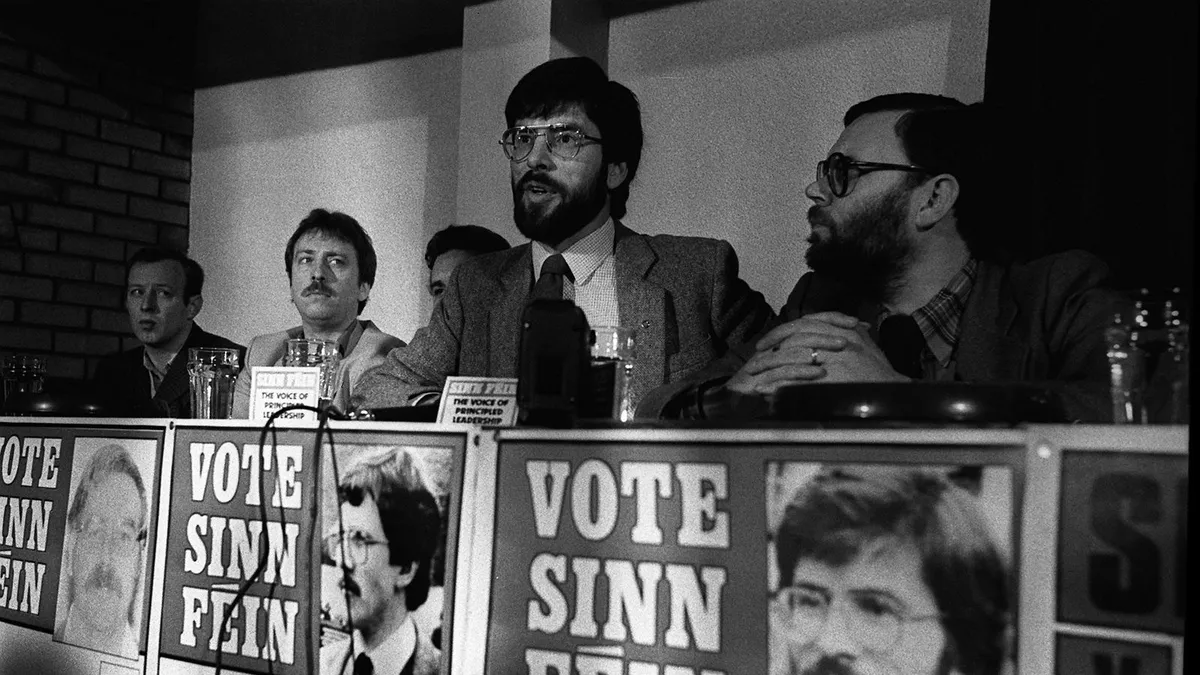
“To be clear, membership of the political party, Sinn Féin, does not equate to membership of the IRA,” stated Gerry Adams as he took the witness stand in London on March 17, 2026. The former leader of Sinn Féin, now 77 years old, is facing a legal case brought by three individuals who claim they were injured in IRA bombings in the 1970s and 1990s.
During his testimony, Adams emphatically denied being a member of the IRA, asserting, “I was never the commanding officer, or OC of the 2nd Battalion of the IRA’s Belfast brigade.” His statements come as the claimants seek symbolic damages of £1 each, alleging that Adams was responsible for bombings that occurred in 1973 and 1996, including the notorious Old Bailey bombing and the Docklands and Manchester bombings.
Adams expressed his belief that Sinn Féin and the IRA are distinct entities, emphasizing, “Sinn Féin is a political party that seeks a whole range of political objectives, including an end to partition and Irish unity.” He further clarified his position regarding the actions of the IRA, stating, “I do not stand by everything that they did, but these were my neighbours.” This statement reflects the complex relationship between political aspirations and the violent history associated with the IRA.
The court proceedings have drawn significant attention, given Adams’s controversial history in Northern Ireland’s political landscape, where he has been a prominent figure for over 35 years. His leadership of Sinn Féin has often been scrutinized due to the party’s historical ties to the IRA, making his testimony particularly noteworthy.
As he entered the witness box, Adams wished the judge a “very happy St Patrick’s Day,” a gesture that may have been intended to lighten the atmosphere amid serious allegations. Despite the gravity of the claims against him, Adams has never been arrested or charged in connection to the bombings in question, which adds another layer of complexity to the ongoing legal battle.
Legal experts and political analysts are closely monitoring the case, as it could have implications for the perception of Sinn Féin and its leadership in contemporary politics. The outcome may influence public opinion and the party’s future, especially in the context of ongoing discussions about Northern Ireland’s political landscape.
Details remain unconfirmed regarding the next steps in the legal proceedings, but the testimonies and evidence presented in court are expected to shape the narrative surrounding Adams and his role in the historical context of the IRA’s activities.