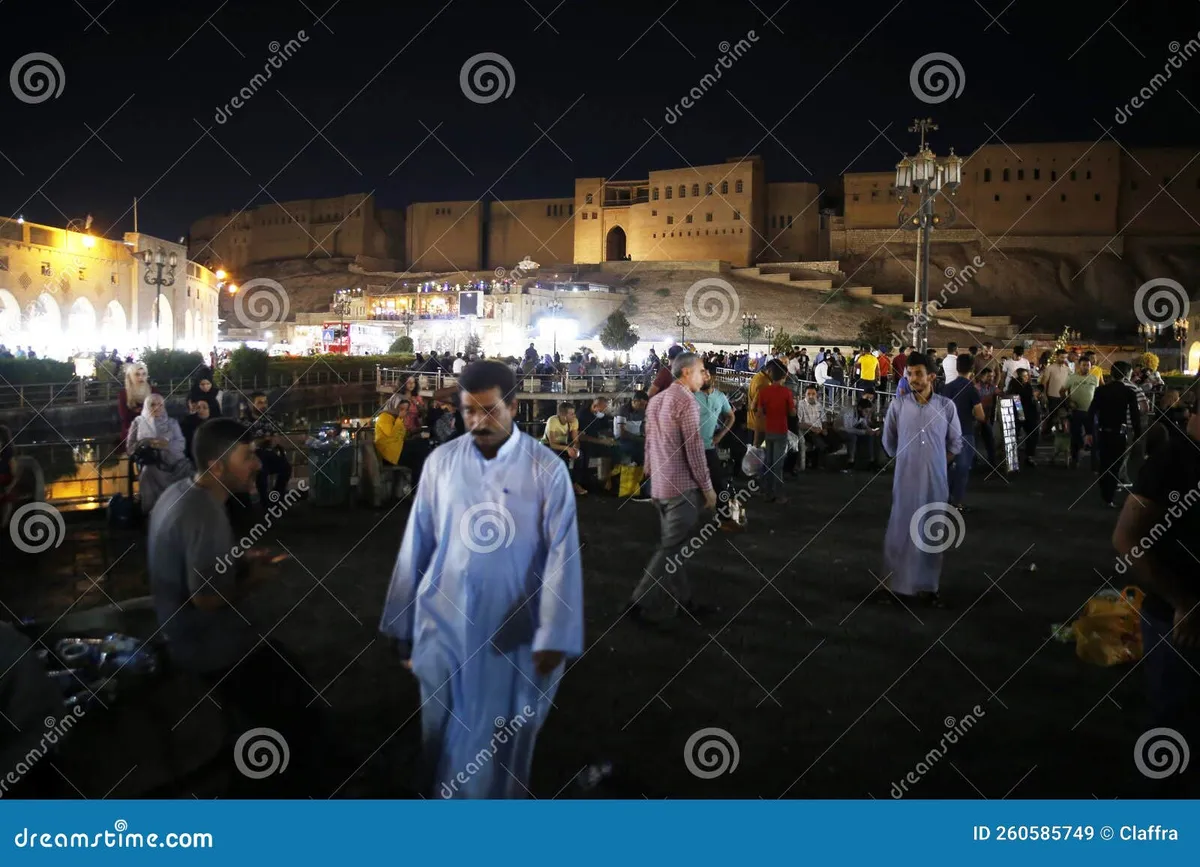
A view of Erbil at night following the drone strikes on the airport conducted by the Islamic Resistance in Iraq on March 1, 2026. Image: Social media
The Islamic Resistance in Iraq, a coalition of covert pro-Iran militia factions, has emerged once again amid the escalation of the conflict involving the US and Israel against Iran, executing assaults on American installations in Iraq and the Kurdistan Region.
Drone Strikes on Airport
ERBIL, Kurdistan Region of Iraq – On Monday, a drone approached Erbil International Airport. Shortly thereafter, flames erupted into the air, followed by a loud blast. The Islamic Resistance in Iraq, a coalition of covert pro-Iran militia factions, has taken credit for numerous such assaults, indicating their revival.
Since the onset of the conflict involving the US and Israel against Iran, Erbil has experienced over 70 missile and drone strikes, as reported by Iraqi Foreign Minister Fuad Hussein. As of Monday night, drones are still patrolling the skies above the city, causing widespread anxiety and confusion among its residents.
It is evident that not all of these drones originate from Iran. On Sunday, the Islamic Resistance in Iraq, a coalition of pro-Iranian Iraqi militias, released a statement claiming responsibility for 23 assaults utilizing numerous drones targeting US installations in Iraq and the Kurdistan Region.
Islamic Resistance Claims Responsibility
During the initial phase of the Israel-Gaza conflict in October 2023, the Islamic Resistance in Iraq was notably active; however, since November 2024, their involvement has significantly diminished. At that time, they focused on attacking Israeli, Kurdish, and US targets.
Ultimately, the coalition of groups ceased its operations, responding to pressure from Baghdad to avoid involving Iraq in regional disputes.
The Iran-aligned militias within the network have specifically targeted American forces in an effort to compel their withdrawal from Iraq. However, Baghdad opted for a diplomatic solution and finalized an agreement with Washington in September 2024, ensuring that all US-led coalition troops would exit Iraq by 2026.
Escalation of Regional Conflict
On Monday, Phillip Smyth, a researcher specializing in Shiite militant groups, informed The New Region that these factions remain perpetually active, stating, “they merely pause their armed operations while continuing to disseminate material [threats].”
Last year, groups linked to Iran also executed assaults on the oil infrastructure in the Kurdistan Region, particularly affecting Erbil, Iraq.
On Monday, Saraya Awliya al-Dam, part of the Islamic Resistance in Iraq, launched an assault on the US military’s Camp Victory base located at Baghdad International Airport “using a fleet of drones.” The organization stated that this offensive was a response to the assassination of Ayatollah Ali Khamenei, the Supreme Leader of Iran.
Impact on Kurdistan Region
Groups linked to the Islamic Resistance in Iraq have initiated demonstrations around the heavily secured Green Zone in Baghdad, where the US embassy is situated, making several attempts to breach the compound.
Victoria Taylor, who previously served as the US Deputy Assistant Secretary of State for Iraq and Iran and led the Iraq Initiative within the Atlantic Council’s Middle East program, informed The New Region that “As US troops withdraw from federal Iraq and relocate to Kurdistan, Erbil Air Base, located near the city’s airport, emerges as the most apparent military target for the US in Iraq.”
Smyth claims that the network serves as a facade for more influential pro-Iran factions like Kataib Hezbollah, indicating that it is not an authentic organization.
“It is manned by individuals from Kataib Hezbollah. The so-called ‘Islamic Resistance in Iraq’ serves as a facade that encompasses various other groups, all of which are overseen by Kataib Hezbollah, Kataib Sayyid al-Shuhada, Harakat Hezbollah al-Nujaba, Harakat Ansar Allah al-Awfiya, along with several smaller factions linked to Kataib Hezbollah,” he stated.
Nicolas Heras, Senior Director of the Strategy and Programs Unit at the Academic Division of the New Lines Institute, emphasized that the Popular Mobilization Forces (PMF) “are most effective for Iran when deployed against targets within Iraq.”
Opposition groups from Iranian Kurdistan located in the Kurdistan Region have faced assaults, alongside the US military installation close to Erbil International Airport, the US Consulate General, and the Harir airbase situated in northeastern Erbil.
“Erbil serves as a crucial forward operating base for the US to gather intelligence and is also a key location for covert operations aimed at Iran. Groups within the PMF can initiate strikes on Erbil to hinder American efforts with little warning,” Heras noted.
“We find ourselves in a different situation now. Iran is truly cornered this time, which explains why their proxy networks in Iraq might be directed to escalate their actions more than they did during the conflict in June. The Iranians must demonstrate their ability to inflict damage and restore some level of deterrence, or else their credibility will be entirely undermined,” Almeida stated.
On Monday, Iraqi Prime Minister Mohammed Shia’ al-Sudani instructed the nation’s security forces to “address and counter any actions” that might pull Iraq into a regional conflict, as Iran continues to engage in hostilities with the US and Israel.
In the past, Kurdish authorities have expressed frustration over Baghdad’s inability to stop such assaults, particularly during attacks on the oil and gas facilities in the Kurdistan Region, including the vital Khor Mor gas field located in Sulaimani province.
Analysts also believe it is improbable that Baghdad will cease these assaults.
“They would need to take decisive action against some very significant and powerful organizations, as well as smaller networks and the interconnected interests involving the Iraqi government—which encompasses numerous Iranian proxy factions, Iran itself, and various militias,” Smyth remarked.
“They were ordered to halt the assaults from Iran, yet even then, it was somewhat disorganized – we still experienced a few attacks weeks after the truce. Currently, there are no directives from Iran to cease the assaults – indicating the exact contrary. It seems likely they will continue to strike and possibly even intensify,” Almeida further remarked.
It is probable that assaults by the Islamic Resistance in Iraq and various pro-Iran factions will persist until a possible agreement is established between Washington and Tehran, or if the Islamic Republic faces collapse and a change in regime occurs.