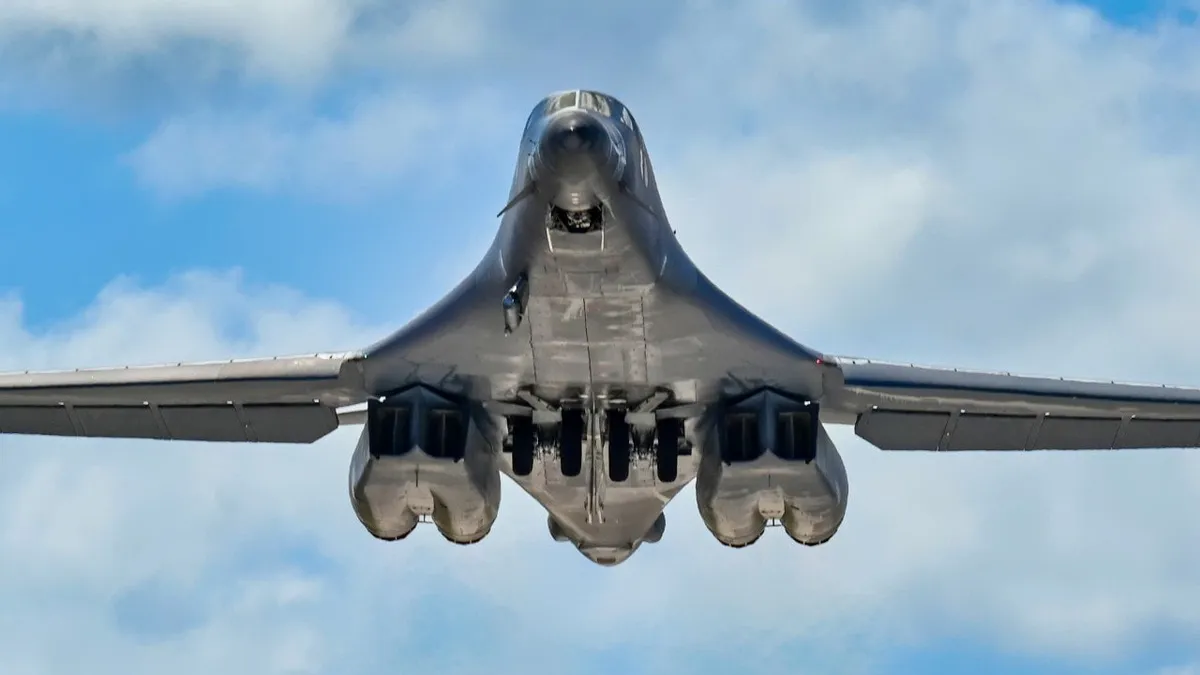
It has been verified, following discreet monitoring by enthusiasts, that USAF B-1B Lancer strategic bombers, departing directly from South Dakota, were engaged in operations against Iranian military targets.
During a live press briefing, General Dan Caine, the Chairman of the Joint Chiefs of Staff, reported on Operation Epic Fury, where U.S. officials verified the deployment of B-1B Lancer bombers targeting Iranian ballistic missile installations and command & control facilities.
Operation Epic Fury Overview
Following a raid conducted by B-2 Spirit stealth bombers, the B-1 bombers departed from their base at Ellsworth Air Force Base in South Dakota, flying across the Atlantic and through the Mediterranean towards their target area, with support from various aerial refueling aircraft positioned along the way.
🚨According to a U.S. official, B-1 strategic bombers from the U.S. Air Force carried out overnight strikes targeting above-ground ballistic missile and command and control facilities in Iran — Barak Ravid (@BarakRavid) March 2, 2026
As aviation enthusiasts monitored the movements of callsigns BONE 01, BONE 02, and BONE 03 over the U.S. East Coast, the United Kingdom announced its decision to permit the U.S. to utilize its bases, such as RAF Fairford and Diego Garcia, for specific mission types. This development sparked speculation about whether the B-1 bombers would first head to Fairford to establish a forward operating base or conduct a strike in Iran before proceeding to Diego Garcia in the Indian Ocean.
Targeting Iranian Military Assets
Ultimately, the bombers executed a comparable round robin mission to the B-2s, withdrawing from the area along the same path back to Ellsworth. However, the option to utilize Fairford and Diego Garcia certainly enhances flexibility in planning upcoming operations.
While the B-1B features a notably small radar cross section for its size, it is not classified as a stealth aircraft in the same category as the B-2 Spirit. The specific types of munitions utilized by the B-1s during this operation remain uncertain, although the aircraft is equipped with various long-range standoff strike weapons that enable it to engage targets from a safe distance, avoiding potential air defense systems. In contrast, it is known that the B-2 strike involved the use of 2000 lb guided bombs, indicating that the aircraft had to operate within a relatively short distance from the target.
The term “2000 lb bombs” likely denotes the GBU-31(V)3/B series JDAMs, which are equipped with a warhead designed for penetrating hard targets. Each B-2A has the capacity to carry as many as 16 of these munitions. https://t.co/qiJXNVcepJ — Guy Plopsky (@GuyPlopsky) March 1, 2026
USAF Strategic Bomber Deployment
That said, the ongoing strikes on military sites in Iran by U.S. and Israeli aircraft, utilizing both kinetic and electronic methods, are likely to have considerably weakened Iran’s air defense systems – we have even observed susceptible medium altitude, long endurance (MALE) UAVs such as the Hermes 900 operating well within Iranian borders (although in at least one instance, the drone was ultimately shot down by a missile).
#Breaking: This video appears to capture a Hermes-900 armed drone from the Israeli Air Force, on a mission to locate and eliminate ballistic missile launchers in #Shiraz, southern #Iran. #IranRevolution #IranRevolution2026 #OperationEpicFury #OperationLionsRoar pic.twitter.com/qLP3rH7e4F — Babak Taghvaee – The Crisis Watch (@BabakTaghvaee1) March 2, 2026
In the upcoming contribution from Air Force Global Strike Command (AFGSC), we might witness the deployment of B-52 Stratofortress bombers, which can utilize various standoff strike weapons. Alternatively, we could observe a collaborative effort between the B-1 and B-2 forces, taking turns to execute these long-range missions to enhance their operational longevity.
Aerial Refueling Support Missions
Fighter aircraft operating under the U.S. Central Command (CENTCOM) continue to target Iranian positions while also defending against missile and drone strikes from Iran. So far, three F-15E Strike Eagles have been lost due to friendly fire, but there have been no reported injuries. In addition to targeting military installations, U.S. and Israeli airstrikes have also struck known government sites, with one such operation leading to the death of Ali Khamenei, the Supreme Leader of Iran.
B-1B Bomber
The B-1B, which evolved from the earlier B-1A that was developed and subsequently scrapped in prior years, was introduced in the mid-1980s as a more survivable option compared to the B-52 for the delivery of nuclear weapons. It relied on speed and low-altitude flight as its defensive strategy, featuring variable geometry ‘swing wings’ and four afterburning GE F101 engines that enabled near-supersonic speeds at low altitudes (and supersonic speeds at higher altitudes) while still offering significant maneuverability at reduced speeds.
The Rockwell B-1 Lancer soaring through the sky, showcasing its camouflage design from 1980. Known as the “Bone,” it carries a maximum payload of 75,000 pounds, making it the most substantial of all U.S. bombers.
Four B-1A prototypes were constructed during the 1970s.
B-1B bombers: a total of 100 manufactured between 1980 and 1988 pic.twitter.com/qB928OX6Bp — Chris Bolton (@CcibChris) November 20, 2025
The nuclear capabilities of the B-1B were ultimately removed in 1994 to adhere to arms reduction agreements, transforming it into a solely conventional bomber. It boasts the highest payload of any active U.S. strategic bomber and has participated in missions over Yugoslavia, Iraq, Afghanistan, Libya, and Syria. Its significant payload capacity and extended loiter time at high altitudes rendered it an exceptional ‘bomb truck’ for close air support in relatively uncontested airspace, resulting in the Lancer being nearly permanently stationed in the Middle East throughout the early to mid-2010s. During the initial months of Operation Inherent Resolve, B-1Bs executed almost 10% of all combat sorties, delivering thousands of munitions.
“Together, these systems have successfully intercepted numerous ballistic missiles aimed at U.S. forces, our allies, and regional stability. The threat posed by one-way attack UAVs has remained ongoing. Our systems have demonstrated effectiveness in neutralizing these threats, swiftly engaging targets. Each successful interception reflects countless hours of training, preparedness, and technology, all functioning as intended.”
At the conclusion of the briefing, Gen. Caine also recognized the loss of three F-15E Strike Eagles. These aircraft were reportedly downed by air defenses in what has been characterized as a friendly fire incident, with CNN indicating that one of the planes may have crashed near the Ali Al Salem base in Kuwait.
“I acknowledge the loss of three U.S. Air Force F-15Es in the area overnight,” stated Caine. “I’m thankful for the crews’ safety, and we understand that this incident did not result from enemy fire. Since this situation is currently under investigation, I will refrain from making any further comments.”
CENTCOM has confirmed via a social media post that B-1B Lancer bombers were utilized during the night of March 1 and 2 to conduct strikes “deep within Iran to diminish Iranian ballistic missile capabilities.” The command did not disclose specifics regarding the number of bombers or the munitions used.
A video linked to the post depicts teams boarding one of the planes, followed by the nighttime departure of three B-1 bombers, with one prominently displaying its EL tail flash. This aligns with previous reports indicating that three B-1 bombers from Ellsworth Air Force Base in South Dakota participated in the strike operation.
Last night, U.S. B-1 bombers conducted strikes deep within Iran to undermine its ballistic missile capabilities. As the President remarked, “we will obliterate their missiles and completely dismantle their missile production.” pic.twitter.com/tIkIo5ugWv — U.S. Central Command (@CENTCOM) March 2, 2026
This article addresses an evolving situation and may receive updates as additional information emerges.