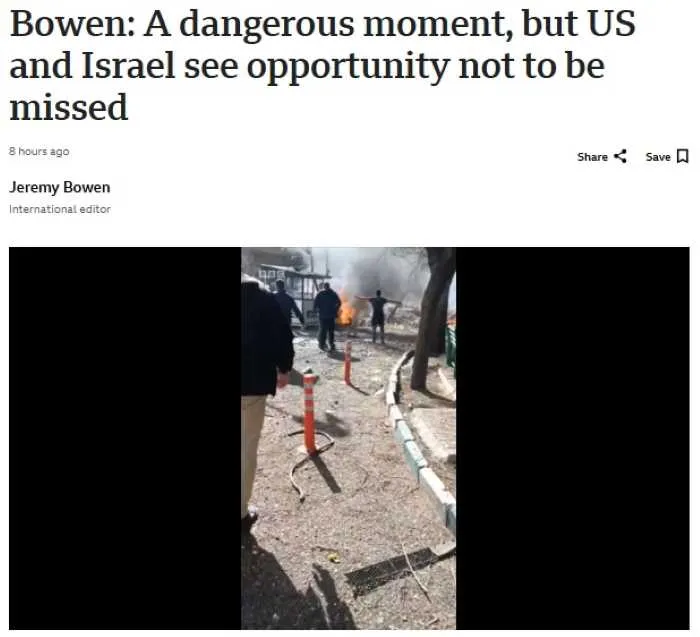
Just hours after the United States and Israel initiated a coordinated strike on Iran on the morning of February 28th, Jeremy Bowen, the BBC’s international editor, published an article on the BBC News website titled “Bowen: A perilous moment, yet the US and Israel perceive an opportunity that should not be overlooked.”
This article advocates for several significant – yet deceptive and unproductive – discussion points, the first of which is outlined as follows: [emphasis added]
US and Israel’s Coordinated Strike
“Israel employed the term “pre-emptive” to rationalize its assault – the most significant in the history of the Israeli Air Force, as stated by the Israel Defense Forces.
The indication is that this does not constitute a reaction to an immediate danger, as the term pre-emption suggests. Rather, it represents a conflict of choice.”
Bowen’s assertion that the actions taken by the US and Israel were not pre-emptive completely overlooks the weeks of rising tensions and threats of imminent conflict. Although Bowen claims to possess “evidence,” he fails to disclose to BBC viewers what that evidence entails or what it is purported to demonstrate.
Understanding Pre-emptive Actions
Jeremy Bowen subsequently informs the audience that:
“The United States and Israel have determined that the Iranian Islamic regime is in a precarious position, grappling with a significant economic downturn, the repercussions of a harsh response to protests earlier this year, and defenses still severely compromised from last summer’s conflict. Their assessment appears to indicate that this is a chance that must not be missed.
This represents yet another setback for the fragile framework of international law.”
Implications for Regional Stability
Bowen does not specify which aspect of “international law” he believes has suffered “another blow.” He neglects to recognize that Israel has been engaged in a prolonged armed conflict with Iran – a situation that has persisted for years – nor does he mention that Iran openly advocates for the destruction of Israel, a sentiment frequently expressed by its leaders and officials.
Jeremy Bowen subsequently creates a fictitious legal rationale:
“In their remarks, both Trump and Israeli Prime Minister Benjamin Netanyahu asserted that Iran poses a threat to their nations – Trump claimed it was a worldwide threat. The Islamic regime is undoubtedly their fierce adversary. However, it is difficult to understand how the legal basis for self-defense is applicable considering the vast imbalance of power between the US and Israel on one side and Iran on the other.”
Critique of Bowen’s Analysis
After proposing that the actions of Israel are linked to the election campaign of its current prime minister (a notion that BBC viewers have encountered previously, including from Bowen, regarding various conflicts), Bowen shifts focus to the topic of the Iranian nuclear program.
“As the US positioned two carrier strike groups in the area along with significant land-based military assets, Trump frequently discussed the threats posed by Iran’s nuclear aspirations, despite having previously claimed that the Iranian nuclear program had been ‘wiped out’ after last summer’s conflict.”
The Iranian government has consistently claimed that it does not seek nuclear weapons; however, it has enriched uranium to levels unsuitable for civilian nuclear energy. At a minimum, it appears to desire the capability to develop a bomb. Up to this point, neither Israel nor the US has provided any proof that such an event is imminent.
Last year, the Israeli Ministry of Foreign Affairs released a document addressing the legal implications of the June 2025 conflict between Israel and Iran, which encompasses the following points:
“In recent months, alongside its heightened uranium enrichment efforts, the Iranian government has also intensified secret initiatives aimed at developing all the technological elements required to construct a nuclear weapon. Iran has been engaged in work on neutron initiators, which are essential for initiating the nuclear chain reaction, as well as on multi-point detonation systems that facilitate the operation of a nuclear explosive device. Furthermore, Iran has conducted nuclear-related computer simulations, managed high-explosive testing facilities, and established underground infrastructures to hide vital assets. Additional activities have included the adoption of passive defense strategies such as camouflage and enhanced launch capabilities that minimize detectability and improve survivability.
The concurrent and swift advancement of these initiatives indicated that once finalized, it would have been feasible to swiftly and effortlessly construct a nuclear weapon, thereby hindering the capacity to effectively prevent the regime from implementing nuclear arms. Consequently, the Iranian regime had arrived at a stage where it could manufacture several nuclear weapons in a very brief period and was on the brink of making the process of nuclear weapon implementation irreversible.
Intelligence gathered by Israel suggests that the Iranian regime has also distributed various elements of its nuclear weapons program and fragmented the production process. Components, materials, processes, and personnel have been dispersed across multiple military sites, fortified underground facilities, and within populated civilian regions, all in a secretive manner. This decentralization and covert activity hinder intelligence and operational effectiveness in pinpointing the completion of each component and the exact timing of a breakout, as well as the capacity to accurately, efficiently, and comprehensively disrupt the program once all components are assembled.
“It has become evident that both the US and Israel aimed to eliminate the supreme leader. Israel relies on assassination as a tactic. Over the past two years, it has targeted and killed the leaders of Hamas in Gaza and Hezbollah in Lebanon, along with numerous key figures.”
If Jeremy Bowen had genuinely aimed to enhance the BBC audience’s comprehension of the looming danger that Iran poses to Israel, he would certainly have highlighted the Iranian government’s support and armament of groups that have targeted Israel – such as Hizballah, Hamas, and the Houthis – along with its recently intensified ballistic missile program and the assaults on Israel in 2024.
This is certainly not the first occasion on which Jeremy Bowen has attempted to convince BBC viewers that the actions of Israel are the primary cause of escalating conflicts in the Middle East. Nevertheless, as has been clear for many years, Bowen’s interpretations frequently do little to clarify the narrative for the corporation’s funding audience, owing to his tendency to promote politically charged and misleading narratives, such as those presented in this article regarding “international law” and “the legal basis for self-defense”.
Articles of Interest:
THE STRANGE REPRESENTATION OF THE IRANIAN NUCLEAR PROGRAM BY THE BBC’S ME EDITOR, JEREMY BOWEN
TWELVE YEARS OF ‘ESCALATION’ NARRATIVE FROM JEREMY BOWEN OF THE BBC
JEREMY BOWEN PLAYS NAIVE TO SPIN A COMPLEX NARRATIVE